
The Employee Engagement Growth Model
Organizations can establish strategies, policies, systems, and programs at the enterprise level. But employees experience the conditions that influence engagement through their everyday work.
An Ecosystem, Not a Checklist.
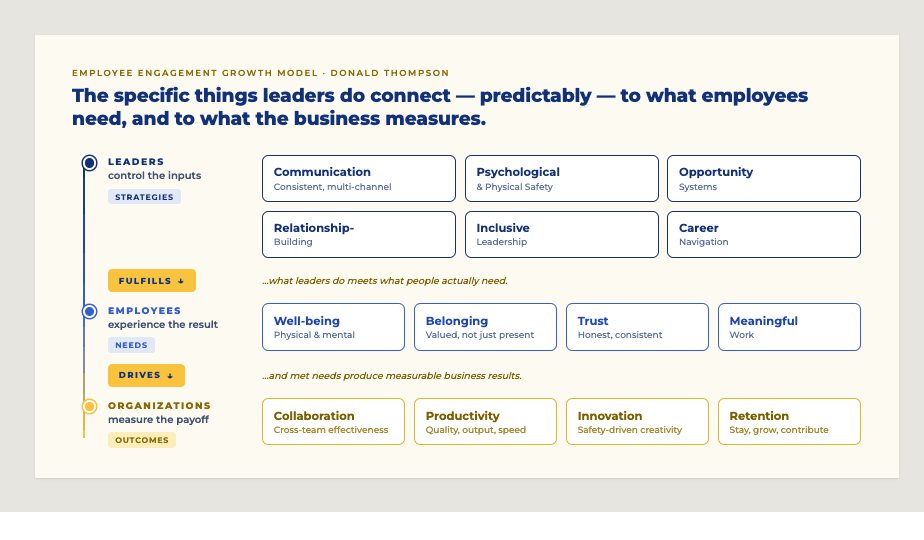
Leadership practices shape the conditions people experience at work. Those experiences influence engagement. Engagement, in turn, is connected to how effectively people and teams perform.
The Six Leadership Strategies
The Employee Engagement Growth Model identifies six areas where leaders can examine the conditions people experience at work.
Communication
Do people understand priorities, decisions, and what is expected of them?
Relationship-Building
Are relationships enabling effective collaboration across teams, locations, cultures, and ways of working?
Psychological and Physical Safety
Can people raise concerns, acknowledge mistakes, contribute ideas, and perform their work safely?
Opportunity Systems
Can people contribute, develop, and access meaningful opportunities?
Inclusive Leadership
Do leadership behaviors enable people to participate and contribute effectively?
Career Navigation
Are people developing the skills and capabilities the organization will need next?
Four individual needs: Meaningful Work, Well-Being, Trust, and Belonging. Four team outcomes: Collaboration, Productivity, Innovation, and Retention.
One Framework. Different Contexts.
Organizations operating across markets face an important leadership challenge: the principles supporting employee engagement can remain consistent while their expression varies by context.
The Workplace Options Center for Organizational Effectiveness Psychosocial Risk by Geography research examines nearly 250,000 lived experiences across 18 countries. It shows why workplace experience must be understood in context, including geography, culture, organizational environment, and local working conditions.
Consistency of principle does not require uniformity of practice.
From Insight to Action
Understand
Connect employee engagement to the business issues the organization is trying to solve and the strategy it is trying to execute.
Examine
Use the Employee Engagement Growth Model to identify where leadership practices and employee experience are supporting engagement and where performance friction may be making execution harder.
Act
Prioritize the areas where leadership action can strengthen the conditions for engagement, then determine how those actions should be applied within the organization's business, organizational, and local context.
Frequently Asked Questions
The Employee Engagement Growth Model (EEGM) is a leadership framework developed by Donald Thompson. It connects leadership practices, individual employee needs, employee engagement, and team outcomes in one operating framework. The model includes six leadership strategies (Communication, Relationship-Building, Psychological and Physical Safety, Opportunity Systems, Inclusive Leadership, and Career Navigation), four individual needs (Meaningful Work, Well-Being, Trust, and Belonging), and four team outcomes (Collaboration, Productivity, Innovation, and Retention).
Move From Engagement Scores to Execution.
The Executive Brief puts the business case for employee engagement, the Employee Engagement Growth Model, and five questions for the executive team in one short document.
Download the Executive Brief